Never Price Off the 69.7 GW: The Deliverability Discount for ERCOT Gas
A transparent way to translate stated nameplate capacity into deliverable megawatts, for hyperscalers pricing offtakes, infra funds underwriting platforms, and developers valuing queue positions.
For hyperscalers · For infra funds · For developers · ercot · gas · framework · deliverability · underwriting
Tafel Power · July 14, 2026 · 4 min read
Every firm-power conversation in ERCOT starts with a nameplate number, and nameplate is the least useful figure in the market. The gas queue reads 69.7 GW. That is a list of study requests, not a supply curve, and everyone in the market already knows to discount it. The problem is that everyone discounts it privately, with their own numbers, in a way no counterparty can check. This piece names the discount and publishes the method.
The framework: three multipliers
The Deliverability Discount applies three transparent multipliers to a project's nameplate megawatts. Each is a number a counterparty can inspect and dispute.
| Factor | Setting | Multiplier |
|---|---|---|
| Interconnection status | Signed interconnection agreement | 1.0 |
| Study advanced, no agreement | 0.5 | |
| Study underway, no agreement | 0.25 | |
| In-service timing | 2026 to 2027 | 1.0 |
| 2028 | 0.85 | |
| 2029 or later | 0.6 | |
| Merchant availability | Merchant developer | 1.0 |
| Cooperative, municipal, or public authority | 0 |
Multiply the three. The result is risk-adjusted deliverable megawatts: nameplate weighted by how likely it is to connect, when it can come online, and whether a merchant buyer can contract it at all.
Applied to the June 2026 ERCOT gas queue
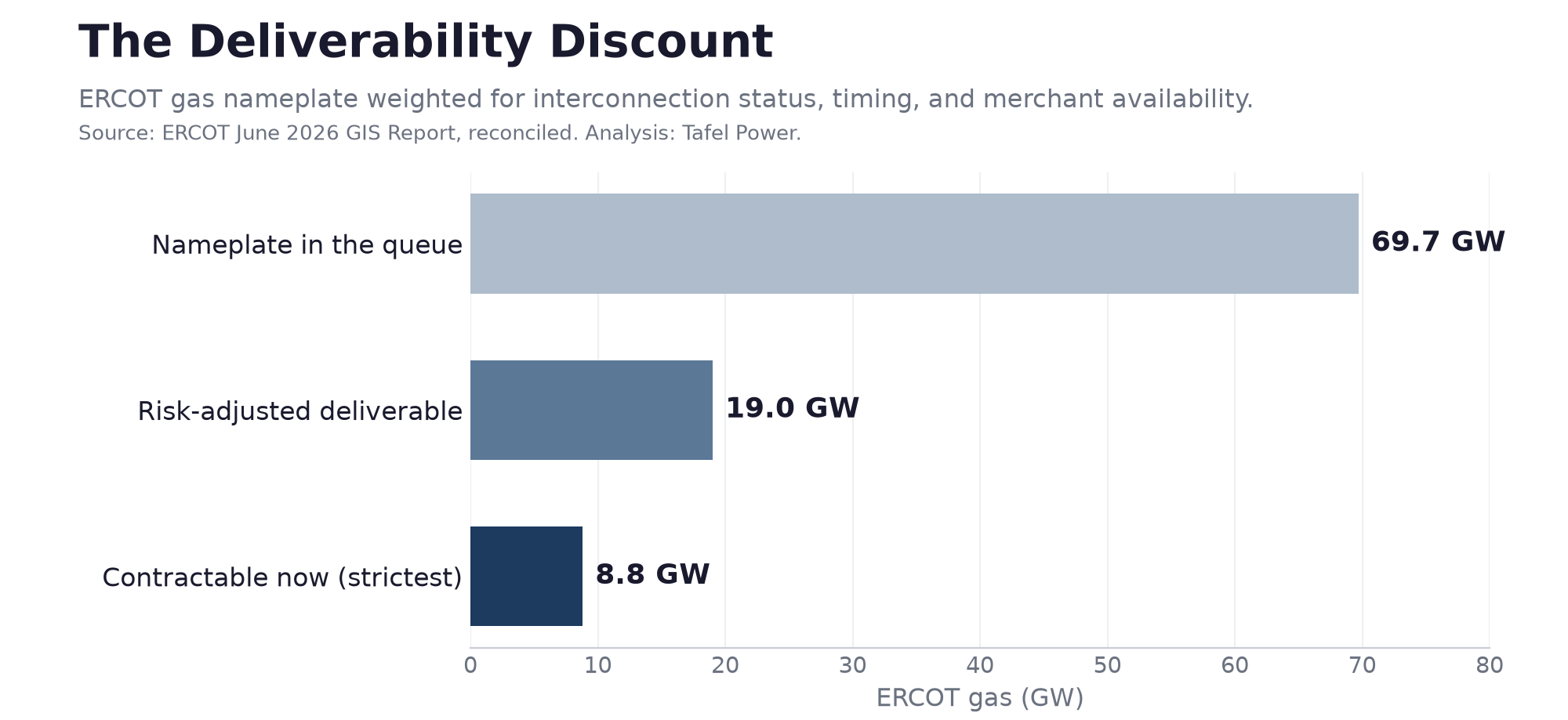
Run every gas project in the queue through the three multipliers and the 69.7 GW of nameplate becomes about 19 GW of risk-adjusted deliverable capacity, 27 percent of the headline. The stack is 14.6 GW signed, 1.9 GW with a completed study but no agreement, and 53.3 GW still in study. Two things then drive the discount. Almost none of the unsigned gas has completed its study, so that 53 GW sits at the 0.25 setting. And most of the unsigned pool also carries a 2029-or-later date, which compounds the timing factor. The signed capacity, by contrast, is mostly near-term and survives the discount.
Set the same framework to a pass-fail filter, full credit only for signed, merchant gas online by 2028 and zero for everything else, and the number is 8.8 GW. That is the figure from the firm-gas overlap analysis. It is not a separate methodology, it is the Deliverability Discount at its strictest setting.
The two numbers answer different questions. 8.8 GW is a floor a buyer can contract against today. 19 GW is a probability-weighted expectation across the whole queue, not a set any single buyer can sign, since no one project is 0.25 deliverable. The deliverable set sits between them, and it is not the 69.7 GW headline.
The multipliers are judgment, and that is the point
The multiplier values are Tafel Power's estimates, not observed frequencies, and they are meant to be adjusted to a user's own risk tolerance. That is the value of publishing them. A conservative underwriter can set the study-underway factor to 0.15 and the 69.7 GW becomes about 15 GW. A more generous one can set it to 0.35 and get about 21 GW. The merchant factor is the most aggressive assumption: a hard 0 on cooperative, municipal, and public-authority gas says a merchant buyer cannot contract it, not that the megawatts do not exist, and relaxing it toward 0.3 would raise the risk-adjusted figure. Across every setting here, from the 21 GW generous case to the 8.8 GW contractable-now floor, nameplate overstates deliverable capacity by three to eight times. What the framework removes is the ability to hide the discount.
What this changes for each user
Hyperscaler energy leads. Price offtakes against risk-adjusted deliverable megawatts, not nameplate. The framework gives a defensible denominator for a competitive process and a number you can put in front of a counterparty without it being dismissed as a private guess.
Infra funds. Underwrite a gas platform on its risk-adjusted deliverable capacity, and stress the multipliers rather than the nameplate. A platform whose value rests on 2029-plus, unsigned megawatts is worth a fraction of its stated pipeline under any reasonable setting of the discount.
Developers. The framework prices exactly what you hold. Moving a project from study-underway to a signed agreement, or from a 2029 date into the near-term window, is a step change in risk-adjusted value, and the discount shows how large that step is.
Methodology
Figures are reconciled from the ERCOT June 2026 GIS Report (Large and Small Gen, projects with a Full Interconnection Study requested) against that immutable source file. Interconnection status is read from the report's IA Signed field and GIM Study Phase; in-service timing from the projected commercial operation date; merchant availability by excluding cooperatives, municipal utilities, and public authorities. The multiplier values are Tafel Power's judgment, published so they can be inspected and adjusted, not an ERCOT-published category, and the 19 GW and 8.8 GW figures are the framework's outputs, not ERCOT figures. Figures reflect the June 2026 snapshot and may have changed since.
All data compiled by Tafel Power from public sources. Framing informed by the firm's transaction advisory work in ERCOT and cross-ISO markets.
For discussions on ERCOT and cross-ISO power transactions, large-load diligence, or AI infrastructure power strategy: kris@tafelpower.com
More from Insights
The Second-Largest Merchant Firm-Gas Queue Is in the Plains
For hyperscalers · For developers · spp · gas · oklahoma
July 12, 2026 · 1 min read
For data centers willing to look past the marquee markets: SPP holds more deliverable firm gas than PJM and MISO combined, mostly in Oklahoma and the Texas Panhandle.
Firm Gas in ERCOT Is a Fifteen-Counterparty Market
For hyperscalers · For infra funds · ercot · gas · procurement
July 11, 2026 · 3 min read
For hyperscalers and infra funds procuring firm power: when the deliverable set sits in a countable number of sellers, price is set by relationship and option value, not by an auction.